Wellbeing of women goes hand in hand with wellbeing of nations
Posted Saturday, 7 Mar 2026 by Haleema Hasan & Siri Aas Rustad
In 2024, 676 million women lived in proximity to conflict, that is almost every 6th woman in the world — the highest number and proportion ever recorded.
It was with this finding, and the weight of what it represents, that researchers, policymakers, and advocates gathered at the Peace Research Institute Oslo (PRIO) offices in Oslo on February 24th, which also marked fourth anniversary of Russia's full-scale invasion of Ukraine.
The timing was not incidental, and the occasion offered reflections on Ukraine. and engaged with findings from the 2025/26 WPS Index — the fifth edition of the most comprehensive global assessment of women's status across Inclusion, Security, and Justice.
Ukraine illustrates both the devastation of war and the resilience of women
Since Russia's full-scale invasion began, Ukraine's security dimension score has fallen by 42% — one of the steepest declines of any country in the Index. The invasion, an external shock over which Ukraine has had little control, has devastated women's security at the individual, communal, and societal level.
And yet, Ukraine today is the highest-scoring fragile state on both Inclusion and Justice. Its Justice score has risen by 24% since 2017. Ukraine is one of only 20 countries globally — and one of only two classified as Fragile States — where all women surveyed report accessing and using cellphones. In a conflict as brutal and protracted as this one, these numbers stand out.
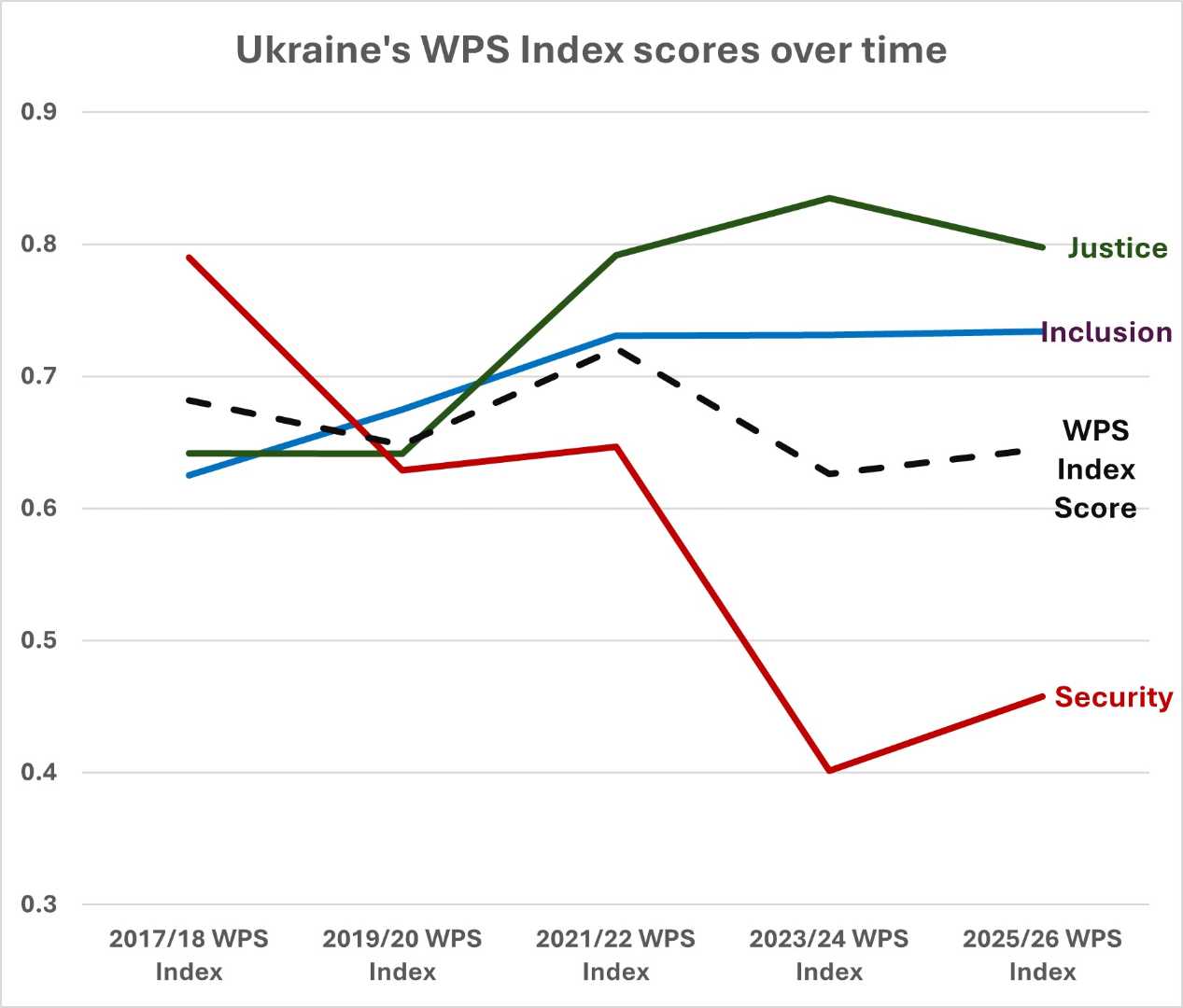
This is pointing to something important: pre-existing investments in women's status, sustained women's leadership in civil society, and active support internationally and from the diaspora may preserve and even advance gains in women’s status despite a severe external shock, as compared to contexts where such a foundation may not exist. More research is needed on this to understand and adopt possible catalysts of positive change for women.
Compounding pressures in the Middle East and North Africa region
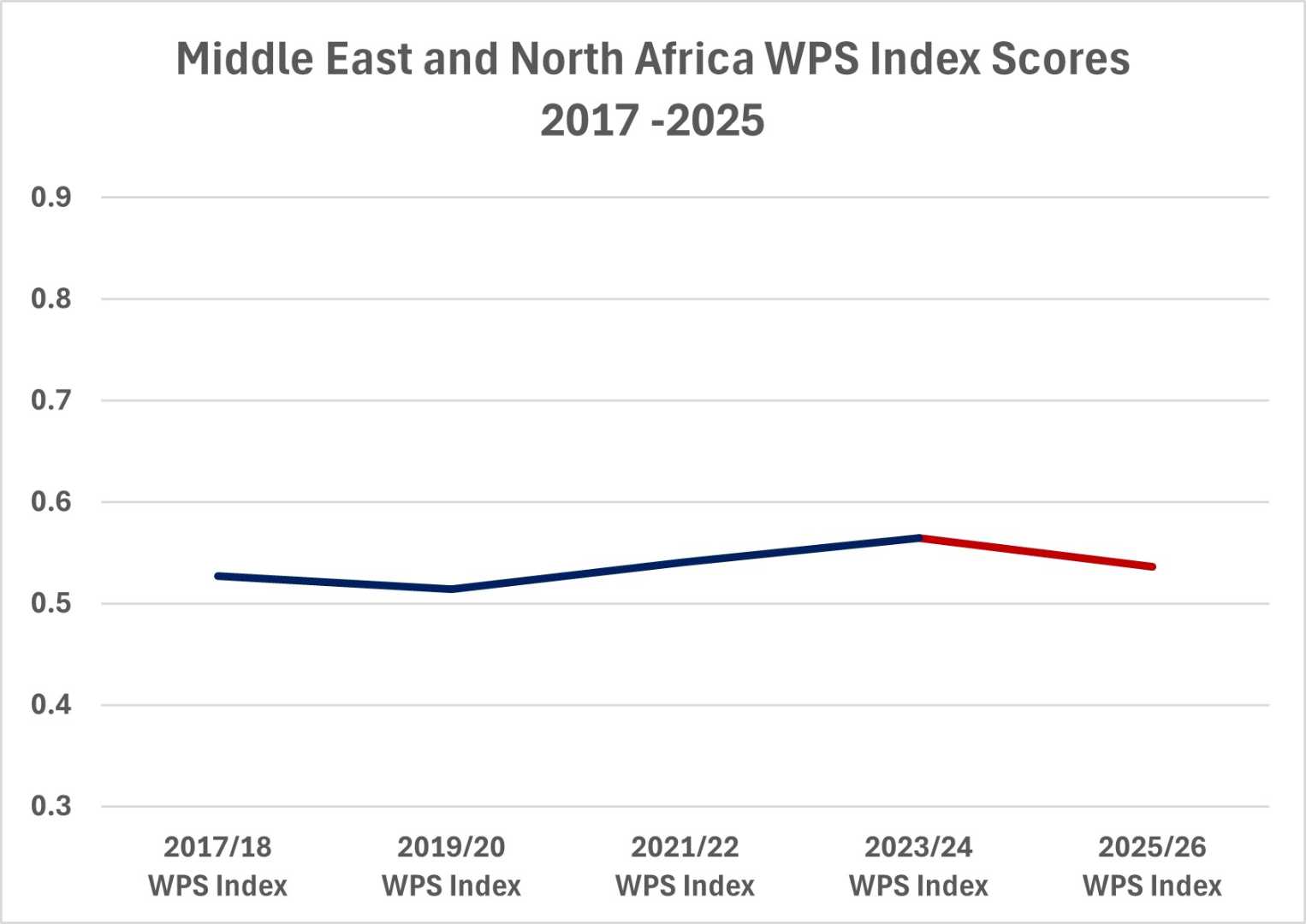
In the Middle East and North Africa (MENA) region, women’s status is impacted in many nations by active conflict, and further geopolitical destabilization will thwart any efforts for improvement. This region currently performs third-worst overall (score 0.536) on the WPS Index, after the Fragile States group and Sub-Saharan Africa. Four of the bottom dozen countries on the WPS Index are in MENA (Yemen, Syria, Sudan and Somalia), and eight of its 20 ranked countries are classified as Fragile States. It has the widest range of scores of any regional group in the Index, reflecting the vast inequalities that characterize women's lives across the region. Progress on women’s status, measured by the group’s average score on the WPS Index, has been on a downward trajectory after improvements in 2021, with the most recent edition showing a sharp decline driven by worsening security conditions as well as gaps in inclusion and justice indicators.
Indicator level analysis further reveals devastating realities. For example, the region is the worst-performing group on employment, with more than three in four women unemployed. Somalia, classified as part of the MENA region, performs worst in the world on education, recording an average of just 0.9 years of schooling for women — the lowest in the world.
But there is possibility of improvement – despite compounding challenges across the region, three of the top ten countries that most improved their WPS Index scores since 2017 are from MENA: Bahrain by 26%, Djibouti by 23%, and Yemen (also a Fragile State) by 21%.
The current US-Israeli attacks in Iran, coupled with the continued attacks in Gaza, the West Bank and Lebanon are likely to worsen conditions in countries across MENA and South Asia as insecurity grows at the individual, communal and societal level. As the data shows, women's status in MENA was already deeply compromised and escalating violence will only worsen living conditions with close to every third women living in conflict, only surpassed by Africa South of Sahel in share of women living in conflict. Women and girls are usually the first victims when conflict erupts, which has been the case with the recent attack on a girls’ school in Iran on the first day of strikes. A girl was killed in Kuwait from injuries after shrapnel fell in a residential area. There are reports of more such attacks.
The evidence is consistent: the closer women live to conflict, the worse their status across every dimension we measure. More women are living in proximity to conflict today than at any point since we began tracking this data. We also see an increase in the share of women living close to more brutal conflicts, in 2024 approximately 112 million women lived in a conflict zone where more than 100 people were killed within a year. This creates both physical security issues such as destruction of infrastructure and food security, but also creating fear for sexual violence, and abductions, leading to retracking form for example school attendance.
A Call to Action
Use the data. The WPS Index exists to inform decisions. Governments, multilateral organizations, and civil society groups can embed Index findings into national action plans, funding priorities, and accountability mechanisms — treating women's status not as a side indicator, but as a core measure of national and global progress.
Advocate for upholding international law obligations amidst rising conflicts, including protection of civilians, especially the most vulnerable such as women, children and minorities. Even as stakeholders work to deescalate current violence, it is imperative, at the minimum, that these obligations are upheld. UNSCR 1325 set forth the WPS framework that outlines both the disproportionate impact of conflict on women and girls, as well as the need for their leadership to build and sustain peace, and the framework must be applied in current contexts.
Center women’s needs and voices, especially in conflict zones. Our data shows that the wellbeing of nations goes hand in hand with the wellbeing of women. It also shows the disproportionate impacts of conflict on women. As the situation across MENA and other conflict zones continues to escalate, the international community must ensure that women are protected and their needs centered and they are leading in peace processes, conflict prevention mechanisms and relief and recovery efforts – they must not be the first casualties of crisis response. Silence and inaction carry a cost that the data will eventually record — but women in Ukraine, Iran, and beyond are living it today. At times of mounting crises, stakeholders need to center women’s needs and voices and deescalate by opting for non violent options.
- Haleema Hasan is Women, Peace and Security Index Research Manager and Lead Author, Georgetown Institute for Women, Peace and Security.
- Siri Aas Rustad is a Research Professor and Research Director at PRIO. She is project leader at PRIO for the WPS Index.
- The Oslo launch of the WPS Index brought together the Georgetown Institute for Women, Peace and Security (GIWPS) and PRIO teams alongside Norwegian Women, Peace and Security focal points, NORAD's Director General Gunn Jorid Roset, the Norwegian Ministry of Foreign Affairs' Special Envoy for Women, Peace and Security Signe Gilen, and Anna Chebotarova, Senior Lecturer at the University of Oslo.
Posted by